Natural speed
Data is captured from people performing tasks at natural working speed, preserving tempo, motion patterns and transitions.

Technology
Mind-1 is MindOn's Physical AI model: an omni-brain that unifies task understanding and robot control. The same model runs fixed dual-arm robots, wheeled dual-arm robots and humanoids.
Human efficiency
Many embodied AI systems can complete a task, but at a fraction of human speed. We measure the time to complete the whole task, start to finish. Shorter is better.
End-to-end task cycle time per item. Bars are scaled within each task. Source: Mind-1 announcement.
One model, multiple robots
Different robots trade off mobility, dexterity, precision, payload and cost. Real deployments will mix them, so the intelligence should not have to be rebuilt for each one.
High-level intelligence
A multimodal model performs scene understanding, task reasoning and behaviour generation, and produces temporally consistent trajectory intent.
Low-level control
A whole-body controller turns intent into fast, smooth motion and handles each robot's own dynamics, balance and tracking.
Human-centric data
Robot-collected data is expensive, tied to one robot, and slow: operators work around the robot's limits, so the model learns cautious motion. Human data captures the task itself, at natural working speed, and is available at far larger scale.
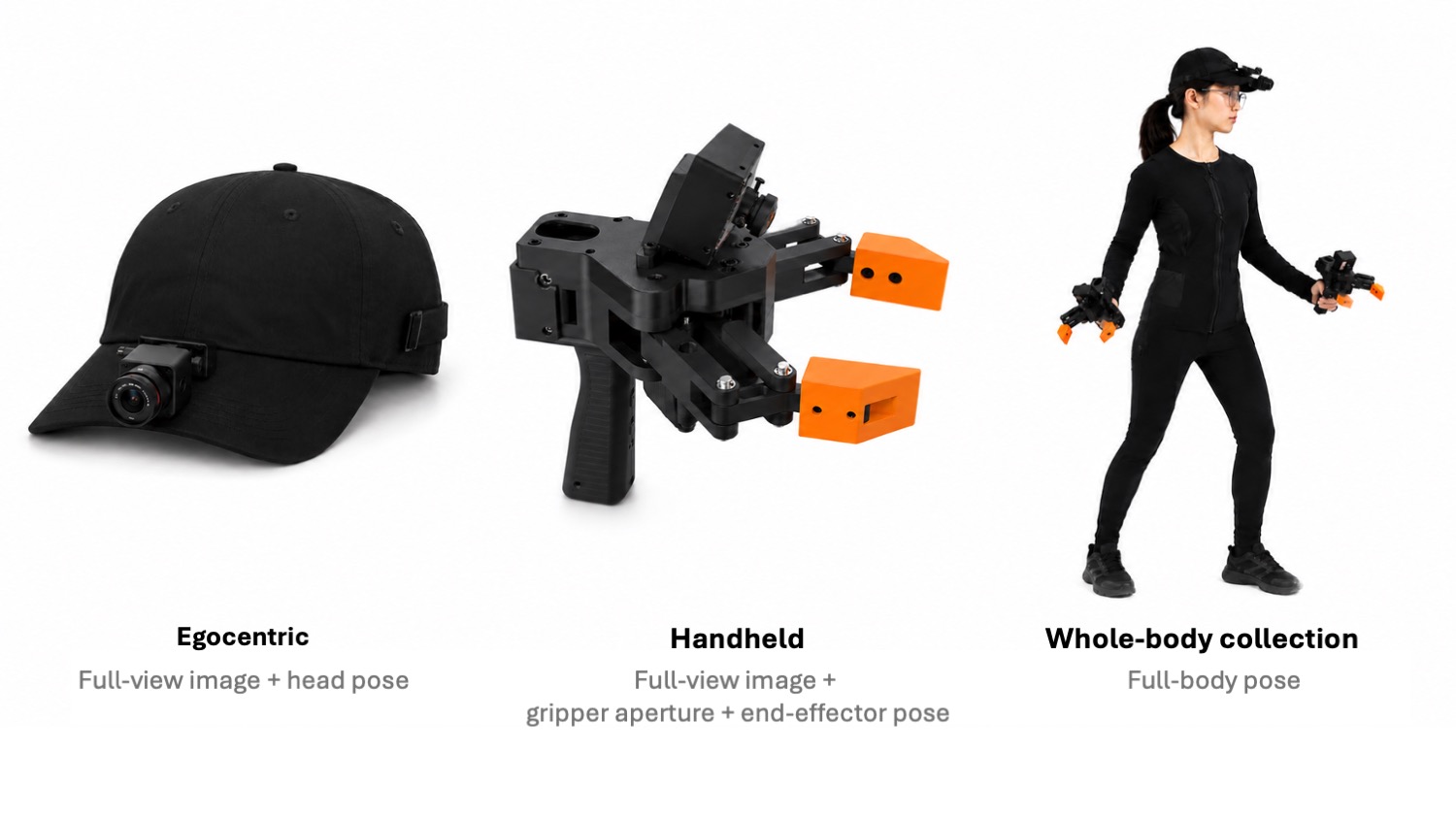
Data is captured from people performing tasks at natural working speed, preserving tempo, motion patterns and transitions.
The in-house collection system captures human manipulation at scale with 1 mm data accuracy.
A data quality pipeline selects demonstrations that are both efficient and suitable for robot learning.
From human behaviour to robot execution
A human body and a robot differ in kinematics, dynamics and workspace, so direct imitation is not enough.
Converts large-scale human demonstrations into robot-executable action representations across different robot bodies.
Learned from tens of thousands of hours of motion capture, it gives one low-level interface for tracking motion while keeping balance.
Sub-3 cm end-effector tracking accuracy
A lightweight model, trained on a small amount of real deployment data, corrects tracking errors and dynamics mismatch on the specific robot.
Sub-1 cm manipulation accuracy on a Unitree G1
The high-level policy reasons over real-time low-level feedback and decides when and how to invoke skills, so execution stays consistent under latency.
Low-latency inference
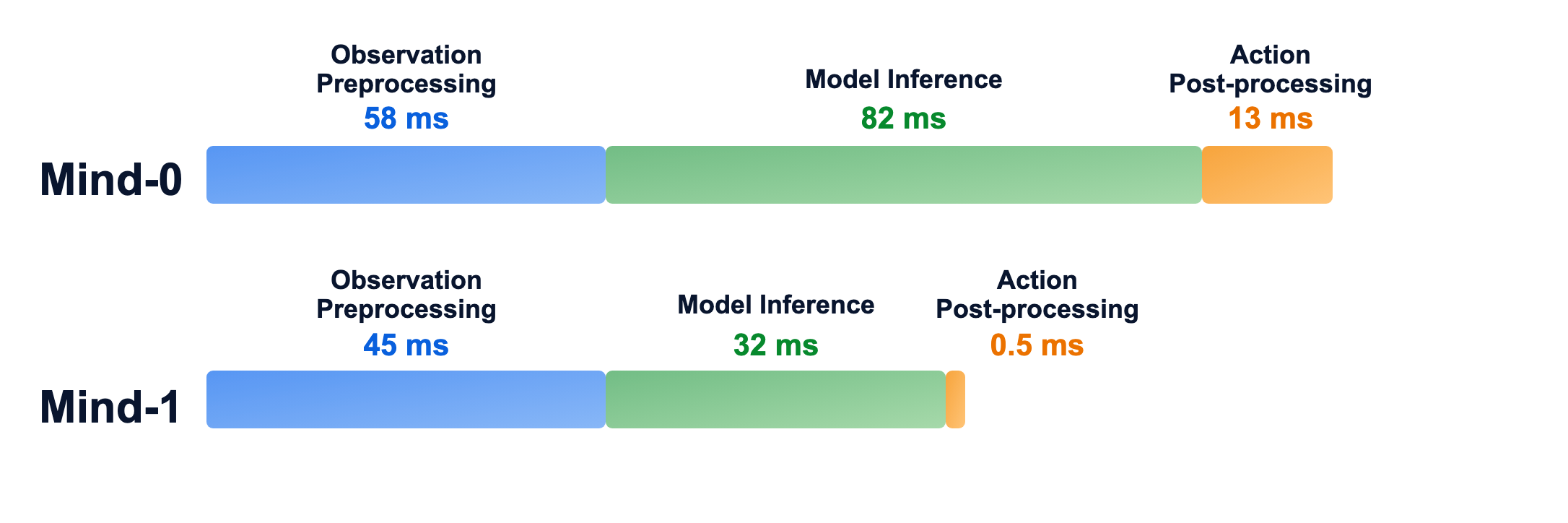
At an end-effector speed of 3 m/s, 10 ms of delay is about 3 cm of movement — enough to miss a grasp. Mind-1 rebuilds the whole loop from camera exposure to robot action.
What comes next
Reaching human-level task cycle time does not mean every challenge of real-world deployment has been solved.
Long-term reliability, failure recovery, safety, integration with existing workflows and deployment economics all need to be validated in real operating environments. That is where Mind-1 is going next, and it is what our feasibility studies and proofs of concept are for. How we work with customers →
Questions
Mind-1 is MindOn's Physical AI model, introduced in September 2026. It is designed to bring robot task execution to human-level speed: across the logistics and everyday manipulation tasks MindOn has evaluated, it reaches task cycle times comparable to a person, and on packaging and parcel sorting it is faster.
The same model has been deployed on three robot embodiments: a fixed dual-arm robot, a wheeled dual-arm robot and a humanoid robot. MindOn separates a high-level intelligence layer from a low-level control layer, so the model is not tied to one robot body.
No. The model is trained on human-centric data: people performing tasks at natural working speed, captured with egocentric, handheld and whole-body devices. A small amount of real robot deployment data is used only for a lightweight compensation model that corrects tracking errors on the specific robot.
By end-to-end task cycle time: the time to complete the entire task from start to finish, not maximum joint velocity or isolated motion segments. For example, packaging takes Mind-1 about 3 seconds, against about 5 seconds for a person.
Mind-0, released in June 2026, showed that one model trained on human-centric data can run both humanoid and dual-arm robots. Mind-1 adds human-level speed: folding went from 80 seconds to 25 seconds per item, and average model inference latency fell from 82 ms to 32 ms.
Human-level cycle time does not mean every deployment challenge is solved. Long-term reliability, failure recovery, safety, integration with existing workflows and deployment economics still need to be validated in real operating environments, which is what MindOn's pilots are for.
Tell us about the task. We will come back with what a first feasibility assessment could look like.